What is a good ROAS? For an ecommerce store, it is a return that covers the costs of fulfilling sales and advertising, with enough left for overhead and your profit goal. A 4x return can still lose money; a 2x return can leave a healthy contribution. The difference is your margin.
Start with your own costs before borrowing another advertiser's target. The examples below show how to judge your current return and calculate the return your business needs.

What Is a Good ROAS for Your Store?
ROAS divides revenue attributed to advertising by advertising spend, as explained in Amazon Ads' ROAS guide. A 3x ROAS means $3 in attributed revenue for each $1 spent on ads. It does not tell you how much remains after paying suppliers, shipping orders, and processing payments.
For a good ROAS for ecommerce, check two numbers together: your actual return and your break-even ROAS. The latter is the minimum needed to cover the costs included in your calculation. See the ROAS formula and worked example if you need to calculate your actual result first.
Industry averages can provide context, but they cannot tell you whether your particular product mix makes money.
Is 2x, 3x, or 4x ROAS Good?
The answer changes with your contribution margin before advertising: the share of revenue left after variable costs such as products, fulfillment, and transaction fees. Fixed overhead is excluded from the following examples.
Suppose each store earns $100 in revenue at 3x ROAS. Advertising costs $33.33. Here is what remains at different margins:
| Margin before ads | Break-even ROAS | Remaining after ads |
|---|---|---|
| 25% | 4.00x | −$8.33 |
| 40% | 2.50x | $6.67 |
| 60% | 1.67x | $26.67 |
These are hypothetical calculations, rounded to two decimals, rather than industry benchmarks. The remaining amount must still cover overhead and other excluded expenses.
Is 2 ROAS good? At a 60% margin, it leaves 10% of revenue after advertising. At a 40% margin, it loses 10%. Similarly, 4x only breaks even before overhead when your margin is 25%. The multiplier becomes useful once you know what it costs to generate that revenue.
Calculate Your Break-Even ROAS First
Gather your selling price after discounts, product cost, shipping and fulfillment costs, payment or marketplace fees, and expected return losses. Use a consistent revenue basis: exclude sales tax you remit, and avoid subtracting refunds twice.
Break-even ROAS = 1 ÷ contribution margin before ads
Express the margin as a decimal. A $100 order with $60 of non-ad variable costs leaves $40, or 0.40. Its break-even point is 1 ÷ 0.40 = 2.5x. At that return, advertising uses the entire $40 contribution.
Enter your product price and costs in the break-even ROAS calculator. If the result looks surprisingly low, check the hidden costs that raise break-even ROAS, particularly fulfillment charges and return losses. A threshold based only on product cost can leave too little room for everything else.
Set a Target ROAS That Leaves Money After Ads
Breaking even on variable costs is only a starting point. Decide how much revenue must remain after advertising to contribute toward fixed overhead and profit.
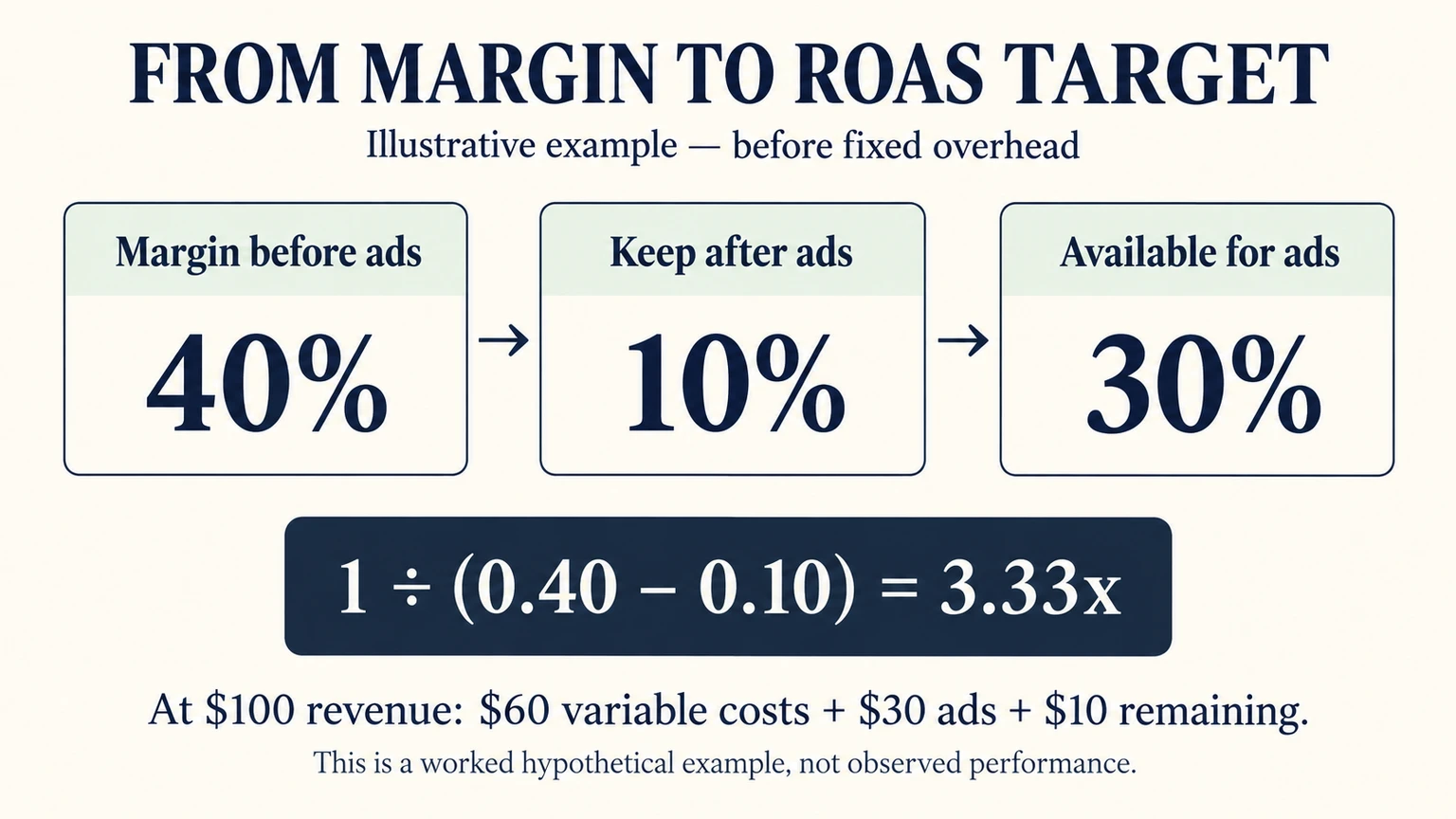
Target ROAS = 1 ÷ (margin before ads − desired margin after ads)
With a 40% contribution margin and a desired 10% remaining after ads, the calculation is 1 ÷ (0.40 − 0.10), or approximately 3.33x. On $100 of revenue, that allows $30 for advertising and leaves $10 before overhead. Use unrounded values when budgeting.
If overhead consumes 8% of revenue at your expected sales volume, that $10 leaves only $2 before other excluded expenses and taxes. Adjust the retained margin accordingly. The formula requires a positive difference between the two margins; advertising cannot preserve a margin as large as the margin available before ads.
Treat this calculation as a business requirement. It does not guarantee that an advertising platform can deliver it. Google's Target ROAS documentation explains that bidding seeks an average return using reported conversion values. Setting an ambitious number cannot repair weak product economics.
Check These Details Before Changing Your Budget
Match revenue and spend to the same reporting period, and allow for purchases that occur after an ad interaction. Compare like-for-like attribution settings; two platforms can claim credit for the same order, so adding their attributed revenue can overstate sales.
Also check whether your result combines new customers with returning buyers. If you accept a lower first-order return because customers reorder, use observed repeat-purchase contribution and a defined payback period. The guide to ROAS and customer lifetime value explores that decision. Future revenue is useful only if its costs and timing also work for your business.
Frequently Asked Questions
Is 300% ROAS the same as 3x?
Yes. Both mean $3 of attributed revenue per $1 of advertising spend. Neither means a 300% profit margin.
What is a good ROAS for Facebook ads?
Start with the same cost-based threshold, then check the revenue attributed by Meta against your store records. The platform name alone does not determine whether a return covers your costs.
Should I stop every campaign below break-even?
First verify attribution, conversion delays, and costs. Any planned loss should have a clear budget limit and a credible payback case. Persistent losses without those conditions need correction before more spending.
Choose Your ROAS Target From Your Costs
What is a good ROAS for your business comes down to the amount left after costs, at a sales volume you can sustain. Calculate your break-even point, reserve enough for overhead and profit, and compare actual performance with that target. Use the free ROAS calculator to check your current return before deciding what to change.